
Agricultural economics is rife with trade-offs. Pesticides increase crop yields (lowering prices for consumers) but damage the environment and human health. Global food trade reduces insecurities yet can lead to dire geopolitical conflicts. And the continuing effects of climate change worsen all these scenarios. “Extreme heat is the main driver of agricultural yields,” notes Wolfram Schlenker, Goldberg professor of the global food system at the Harvard Kennedy School (HKS). In the short run, that “might not be that bad for farmers—given that once you restrict supply, you drive up prices,” he says, “but [it] is bad for consumers, especially the poor.” Schlenker chose this field because he likes to grapple with crucial unresolved questions, such as: Can the world continue to feed its growing population? Born and raised in Germany, he spent a year abroad at Duke University as an undergraduate and stayed, ultimately earning a master’s degree in engineering and management science. He completed a doctorate in agricultural and resource economics at the University of California, Berkeley in 2003, then taught at Columbia University before joining Harvard in 2024. At HKS, Schlenker’s work explores important challenges, including: Should we use irrigation water to insulate against drought, even as aquifers are being drained at unsustainable rates? What are the pros and cons of Russia, with its fertile soil still frozen over, becoming a big future breadbasket? When he’s not working, Schlenker likes to bike. The car-free, rails-to-trails routes are antidotal, enabling his mind to wander freely amid natural beauty and to appreciate nature’s complexity. “As a kid, you think nature is an equilibrium,” he says, but “there have always been fights for dominance between different species. Most landscapes have evolved over time.”
Harvard Economist Wolfram Schlenker Is Tackling Climate Change
How extreme heat affects our land—and our food supply

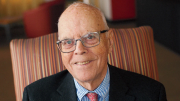
Wolfram Schlenker | Photograph by Jim Harrison
You might also like

On Open to Debate, the Harvard economist defended free market competition—with meaningful government involvement.

From competing in youth gymnastics to studying tetrapods, the Harvard curator has always chased her curiosity.
Plus, veteran higher education leader Thomas Ehrlich reflects on university curricula for his 70th reunion
Most popular


Explore More From Current Issue

The Gretel and the Great War author on how the Lampoon derailed his science career—and set him on a literary path.

David Battat promotes alumni engagement.

Tell us about how social media impacts your daily life.